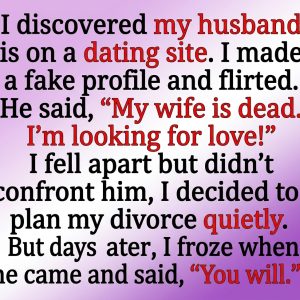
I was using my husband’s laptop one afternoon to print a document when a dating website notification appeared in the corner of the screen. At first, I assumed it was just another advertisement, but curiosity got the better of me. When I clicked it, I froze. There was a dating profile with conversations involving several women, and one sentence made my heart stop: **“My wife is dead. I’m looking for love.”** My hands began to shake. Had my husband really told strangers that I was dead?
For the rest of the day, I couldn’t think straight. Nine years of marriage suddenly felt like a lie. Instead of confronting him, I quietly contacted a lawyer, checked our finances, and started preparing for a future without him. I barely spoke to him, avoided eye contact, and convinced myself I had uncovered the ultimate betrayal. He seemed confused by my sudden distance, but I refused to explain why.
A few days later, my husband came home smiling with another man beside him. “I want you to meet Greg,” he said. “He’s a close friend, and I promised I’d help him.” Seeing my puzzled expression, he explained that Greg had lost his wife two years earlier and had no idea how online dating worked. My husband had simply created the profile for him, uploaded the photos, and even helped write the messages—including the heartbreaking line, **“My wife is dead.”**
Greg quietly thanked my husband for helping him find the courage to move forward after his loss. In that instant, my anger disappeared, replaced by embarrassment and relief. I had nearly ended my marriage without asking a single question. That day taught me a lesson I’ll never forget: sometimes the greatest damage isn’t caused by lies or betrayal—but by the stories we convince ourselves are true before hearing the whole truth.